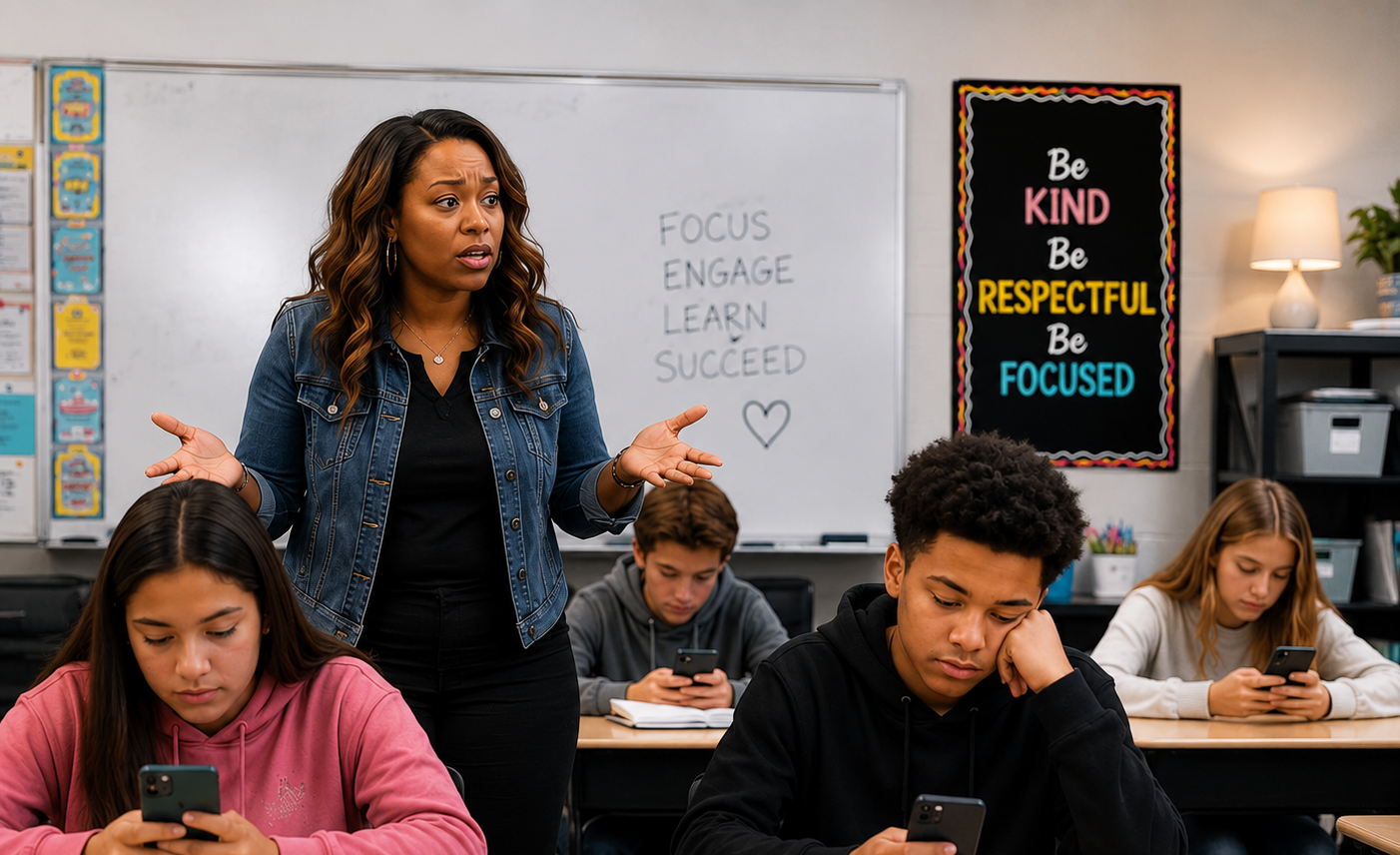
Have you ever spent 30 minutes planning what you thought was the perfect lesson, only to lose your students’ attention within the first three minutes?
You begin explaining the lesson, full of excitement, but before long one student is staring out the window, another is doodling in the margins of a notebook, someone else is tapping a pencil, and a few are probably thinking about the latest viral TikTok video or the video game they played the night before.
Sound familiar?
If you’ve found yourself wondering why your students seem to struggle to stay engaged, you’re certainly not alone. Teachers across the country are asking the same questions.
- Why are students less engaged than they used to be?
- Why can’t they focus during lessons?
- How do I keep students interested without exhausting myself trying to entertain them?
The good news is this: your students’ short attention spans do not mean you’re a bad teacher.
Today’s students are growing up in a world filled with endless notifications, short-form videos, instant gratification, gaming rewards, and constant digital stimulation. Their brains have become accustomed to receiving new information every few seconds. That doesn’t mean they can’t learn—it simply means we may need to rethink how we present information.
The goal isn’t to compete with technology. It’s to teach in ways that work with how students naturally learn.
Here are ten classroom strategies that actually work.
1. Break Lessons Into Smaller Chunks
One of the biggest mistakes teachers make is expecting students to remain focused during long stretches of direct instruction.
Think about it for a moment.
Most adults struggle to sit through a two-hour staff meeting without checking the clock or sneaking and checking their phones. Yet we often expect children to remain fully attentive through a 25- or 30-minute lecture. Really?!
Instead, divide your instruction into smaller pieces. Teach for about eight to ten minutes, then pause.
Give students a chance to process what they’ve learned by asking them to:
- Turn and talk with a partner.
- Answer a quick question.
- Write a short response.
- Draw a visual summary.
- Complete a simple practice activity.
These “brain breaks” aren’t wasted instructional time. They’re just the jolt that our students need to reset their attention before moving forward.
I discovered with my struggling readers, you can’t give them large chucks of information. Instead, you have to break it into smaller pieces. We used to call this “chunking”.
And, you’ll discover that students retain more information once it is broken down into pieces because they’re processing it in manageable chunks instead of trying to absorb everything at once.
2. Start Every Lesson With Curiosity

Curiosity is one of the most powerful engagement tools a teacher has.
Instead of beginning with:
“Today we’re learning about figurative language.”
Try something like:
“What if I told you great writers lie all the time—and teachers actually encourage it?”
Suddenly you’ve captured their attention.
Students naturally want answers to interesting questions. And, trust me. They really want to know that teachers lie. So, you automatically have their attention.
When our students become curious, they lean in before you’ve even started teaching.
Before every lesson, ask yourself one simple question:
“What could I say that would make students want to know more?”
That small shift can completely change the energy in your classroom.
3. Get Students Doing Something Every Few Minutes
Attention isn’t maintained by listening. It’s maintained by participating.
A helpful rule of thumb is to have students do something every three to five minutes.
Participation can be incredibly simple.

Students might:
- Raise their hands.
- Vote on an answer.
- Write one sentence.
- Solve a quick problem.
- Discuss with a partner.
- Sort vocabulary cards.
- Complete a mini challenge.
The more students participate, the less likely they are to mentally check out. Remember, learning is not a spectator sport.
4. Add More Movement to Your Lessons
Children weren’t designed to sit still for hours at a time. I know I sure can’t. Movement naturally increases energy, improves focus, and often reduces classroom behavior problems.
Try incorporating:
- Gallery walks
- Four Corners activities
- Stand-and-share discussions
- Scoot games (One of my favorite ways to get students moving)
- Partner rotations
- Vocabulary stations
Even sixty seconds of purposeful movement can completely change the atmosphere in your classroom.
5. Use Timers and Friendly Challenges
I confess. I have to have a timer to help keep me on track and focused. And, our students do too. They often lose focus because a task feels endless.
Timers provide students with:
- Clear expectations
- A sense of urgency
- A visible finish line
Instead of feeling overwhelmed by a large assignment, students focus on accomplishing one manageable goal at a time.
6. Teach Less and Let Students Practice More
Many teachers feel pressure to explain every detail before allowing students to begin working. Ironically, too much explaining often leads to less learning. Students learn best by applying information—not simply listening to it. And, a neat little trick for those students who love to ask you over and over again what they are supposed to be doing: write the instructions on the board or hand out copies of the instructions.
Ask yourself this question:
Who is doing most of the work in my classroom?
If you’re talking for 80% of the class period, students will eventually tune out.
Instead, flip the ratio whenever possible.
Aim for:
- 20% direct instruction
- 80% practicing, discussing, creating, collaborating, and applying
When students become active participants instead of passive listeners, engagement naturally increases.
7. Tell More Stories
I love stories. And, chances are that your students do too! Stories are unforgettable. Long after students forget your PowerPoint slides, they’ll remember the story you told.
Stories create emotional connections, and emotional connections improve memory. No matter what subject you teach, storytelling can make lessons more meaningful.
8. Reduce Classroom Distractions
Sometimes attention problems aren’t entirely student problems.
Sometimes they’re classroom problems. Take a fresh look around your room.
Ask yourself:
- Is there too much visual clutter?
- Are supplies easy to locate?
- Are transitions organized?
- Are directions simple and clear?
- Is unnecessary noise creating distractions?
While colorful classrooms can be inviting, too much visual stimulation can make it difficult for some students to concentrate.
Creating a calm, organized learning environment allows students to focus on what matters most—the lesson.
9. Build Predictable Classroom Routines
Consistency…consistency! Students feel more secure when they know what to expect. Predictable routines reduce mental fatigue because students don’t have to constantly figure out what’s happening next.
When routines become automatic, students spend less energy managing procedures and more energy learning new content.
Consistency also helps reduce classroom management issues because expectations remain clear every day.
10. Focus on Relationships Before Everything Else
Perhaps the most overlooked engagement strategy isn’t a strategy at all. It’s connection. Students pay attention to teachers they trust.
While strong instructional practices matter, relationships often determine whether students choose to engage.
Take time to:
- Greet students at the door.
- Learn their interests.
- Celebrate small victories.
- Listen when they talk.
- Encourage their growth.
- Show genuine care.
A student who feels seen and valued is much more likely to participate than one who feels invisible. Relationships create the foundation upon which effective teaching is built.
You’re Not Competing With TikTok
Here’s an important reminder every teacher needs to hear.
You are not competing with TikTok.
You are not competing with YouTube Shorts.
You are not competing with video games.
Your job isn’t to entertain students every second of the day.
Your responsibility is to create meaningful learning experiences that challenge students, encourage curiosity, and help them grow.
Student attention spans may be changing, but great teaching still works. When we combine curiosity, movement, participation, storytelling, routines, and meaningful relationships, classrooms become places where students are more engaged and learning becomes more enjoyable.
Other Articles to Read: